The Eight Elements of Abusive Relationships
Breaking down the Power and Control Wheel.
By Robin Arnett, LCSW
Abusive relationships don’t always involve physical violence. In fact, physical violence is only part of a cycle and pattern of behaviors that characterize an abusive dynamic. It is absolutely possible to be in an abusive relationship in which nobody is ever physically harmed.
One of the most helpful tools that I have used in my work is the Power and Control Wheel. This visual tool helps to clearly show that relationship abuse is not just about a single incident when someone gets hit, but rather about a pattern of power and control that takes many different forms.
Almost 10 years after the rapid growth of the #metoo movement, abuse and violence against women is still a relevant and essential concern in the United States and all over the world. The recent documentary Sean Combs: The Reckoning, clearly shows how difficult it is to get people to pay attention when women are being abused, and how minimal the consequences for this abuse often are compared to the damage that is inflicted. It is imperative that we continue to talk about relationship abuse against women, and how deeply it permeates our society.
This blog will flesh out each of the components of the wheel. These elements can take shape on a spectrum of severity. Even if you recognize just one of these elements in your own relationship, it is important to take stock and address it. Nobody should have to put up with abuse. You can take your power back.
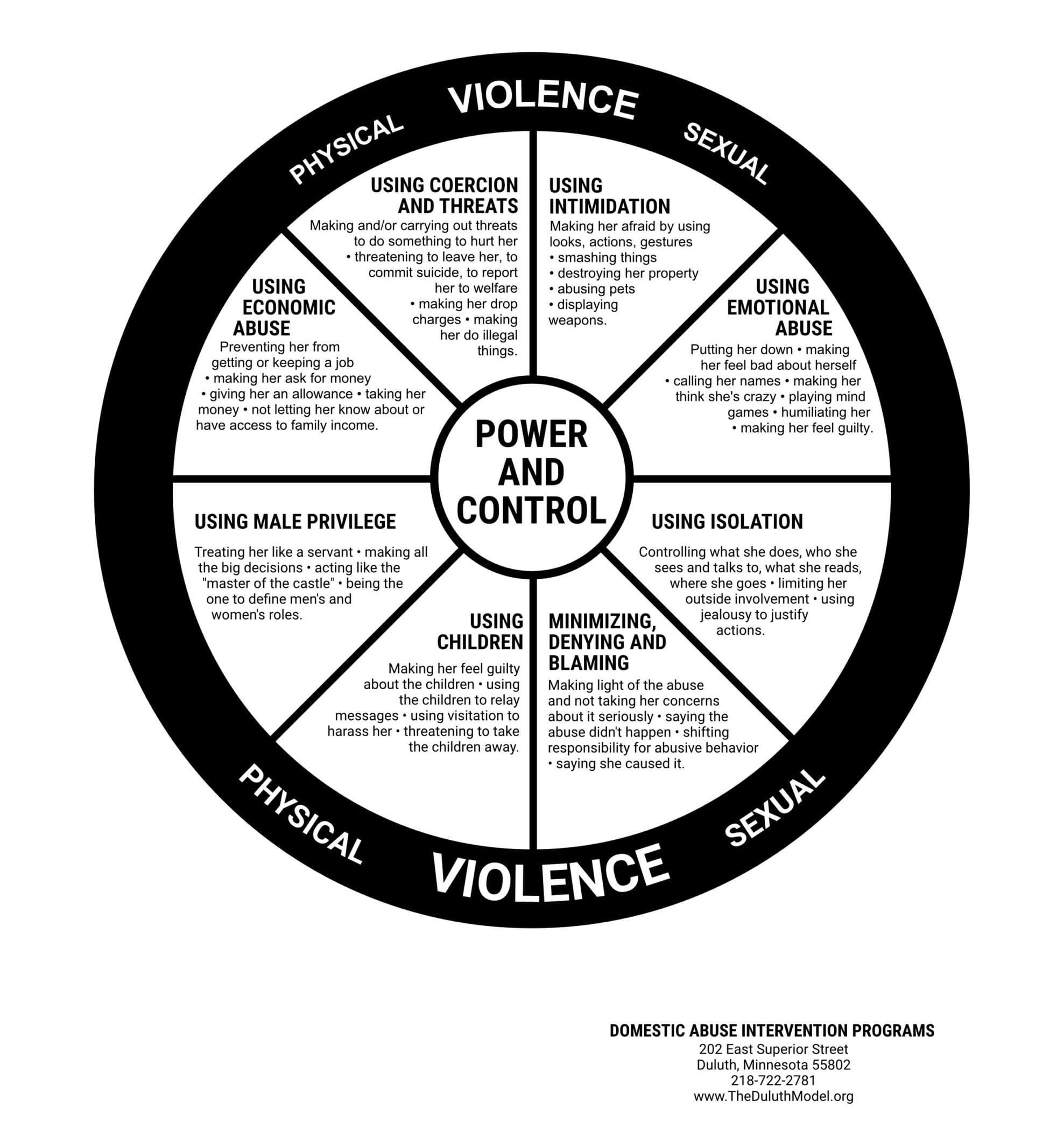
The Power and Control Wheel was developed in 1984 by the staff at the Domestic Abuse Intervention Project (DAIP) in Duluth, Minnesota. The tactics chosen for the wheel were those that were most universally experienced by battered women based on feedback from focus groups at DAIP. The Power and Control Wheel was developed with specific reference to the experience of women in abusive relationships with men based on the client population at DAIP. This specificity is important because of the way that our social structures, including male privilege, teach, support, and reinforce abuse against women. While abuse can certainly take place in same-sex couples or from a woman to a male partner, the data are clear that women in heterosexual relationships experience abuse at both the highest frequency and severity. In fact, men commit 86-97% of all criminal assaults, and women are killed 3.5 times more often than men in domestic homicides.
Personally, I have used this image innumerable times in my work, both in private practice, and in community mental health settings. I have so often seen the “clicks” that happen for people when they realize that what they’ve been experiencing is part of a pattern of behavior that is not isolated to their experience. One of my internships in graduate school was with Sanctuary for Families - an incredible organization in New York City that supports women and children seeking support for domestic violence in their homes. While I was learning there, I clearly remember thinking that it was as if these abusers had all gone to school together to learn how to be abusers. Indeed, the patterns of abuse take shape with shocking consistency across relationships, socioeconomic status, race, and culture.
Here are the ways that abuse most commonly presents:
Using Economic Abuse
Money is power. Economic abuse looks like preventing someone from getting a job or having a way to support themselves independently, using money for control through bribery and blackmail, and hiding financial information. In fact, the lack of resources is perhaps the biggest barrier to escaping an abusive relationship that woman face, especially when there are children involved.
Coercion and Threats
Coercion and threats can look like threats of violence, but can also look like threatening to leave, threatening suicide, or other forms of blackmail. Coercion and threats are where the pressure in an abusive relationship really ramps up. These patterns create a constant tension where it always feels as if the bottom is going to drop out. This leads to a feeling that you are walking on unsteady ground in a state of chronic stress.
Intimidation
Intimidation can be thought of as actions that make the point that violence is an option. Often, the physical imbalance between the man and woman in a partnership is reinforced here. This can look like destroying property, yelling and screaming, looming, abusing pets, or brandishing weapons.
Emotional Abuse
Emotional abuse is where the ground is laid for all of the other forms of abuse mentioned here. This form of abuse is the foundational destruction of self-esteem and self-worth that set the stage for abusive patterns. Emotional abuse looks like criticism, name calling, humiliation, and shaming, and happens on an almost constant basis.
Isolation
Family and friends will often reflect to us that they don’t like that a partner is treating us poorly. Abusers know this, and so they do their best to keep their partners to themselves. This can look like pouting and getting jealous when their partners spend time away from them, criticizing the people in their partner’s life, or refusing to allow their partner to do activities on their own. Abusers also know that getting a taste of life outside of the relationship can show somebody that there is another way to live, and they try to prevent this from happening by jealously guarding time and attention for themselves.
Minimizing, Denying, and Blaming
Minimizing, denying, and blaming can also be thought of as gaslighting. Minimizing, denying, and blaming essentially make light of the experience of abuse, or even deny reality completely. This also looks like shifting the blame for abuse. (“If you hadn’t… etc., etc.”) This dynamic can be crazy-making, and leads to intense self-doubt. This self-doubt is often exacerbated through isolation. The relationship starts to become an echo chamber in which only one person’s reality is allowed.
Using Children
Children are often the most important part of a woman’s life, and abusers can use this love as a mechanism for control. This can look like threatening to take away custody, using visitation as an opportunity for harassment, using children to emotional abuse and shame, or even threatening to harm the children as blackmail. Children can often become pawns in an abuser’s game of power and control.
Using Male Privilege
Using male privilege looks like demanding certain “rights” in a relationship, including subservience, being the one to make all major decisions, being waited upon, and expecting all or the majority of domestic duties to be taken care of by the woman. Using male privilege can show up as an element of all of the aspects of abuse mentioned above. A man may even insist upon his right to hit his partner to “keep her in her place.”
Getting Support
If any of these elements ring true for you, it is likely that your relationship is abusive. This can be a lot to process, and can often trigger feelings of anger, shock, and grief.
If you are currently in danger or feel like you don’t know how to get our of the situation that you are in, The National Domestic Violence Hotline offers 24/7 confidential support via chat, phone, or text, and can be reached via their website, linked above, or at (800) 799-SAFE. They can help you to safety plan, find local support, and identify abuse when it’s happening.
Even if your relationship does not meet a level where you are fearful of violence, you may recognize some aspect of abuse in the relationship that you are in. Even if you think that what you are experiencing is “not a big enough deal” or “isn’t that bad,” I hope that seeing your experience reflected here helps you to be able to name what is happening. Minimizing your experience is a common result of being in an abusive relationship due to all of the tactics discussed here. Know that you deserve better.
If you are looking for resources, you can reach out here to see how we may be able to support you in your journey, or find help in your area through the National Domestic Violence Hotline. Change is possible, and you are worthy of so much more.